
Thank you, Minister Alty. Premier Simpson, and Indigenous leaders from across the North – it’s nice to see many of you again.
It’s good to be back in Yellowknife.
When I was born in Fort Smith, its only route south was a winter road.
A year later, that changed when the all-weather road to Hay River opened, and with it, greater opportunity.
It underlines a simple truth.
Connection is strength.
That principle drives the investments your government is making. The major projects that will build Canada for generations. The local infrastructure that brings communities together. The artists and storytellers who connect us to one another and to the world.
Connection anchors sovereignty – the ability to live as we choose. Sovereignty built on strength at home and diverse partnerships abroad.
We are building a dense web of reliable partnerships around the world – creating more opportunities for our businesses, more choice for Canadians, and less reliance on any single market.
This year alone, we’ve signed seven new trade and investment agreements and launched negotiations toward seven more.
Canada now has 23 trade agreements across 60 countries. Preferential access to over 2 billion consumers, representing over two-thirds of global GDP. And we are just getting started.
Just as Canada becomes the best-connected economy in the world, we are deepening our connections at home.
We are tearing down barriers to trade between provinces. We are building at a speed and scale our country hasn’t seen in generations. New roads to the critical minerals of Ontario’s Ring of Fire and new transmission lines to power the mines in Northwest B.C. Doubling our electricity grid – connecting our power east, west, and north. And exploring high-speed rail from Toronto to Québec City and Edmonton to Calgary.
We are connecting Canadians to each other, our goods to new markets, and our country to the world.
It’s beyond time to connect the North.
In March, we announced our plan to do that.
A plan backed by more than $40 billion in investments.
To strengthen our defence capabilities, build critical infrastructure, connect communities, and unlock the North’s extraordinary potential.
A strong North in a strong Canada.
What does this mean for Canadians?
It means more choice. Lower costs. Better access to essentials. Good jobs. And more opportunity.
These ambitions go hand in hand. They are inseparable. And they are all rooted in our sovereignty.
At the heart of our plan to build and connect the North is a project nearly 70 years in the making: the Mackenzie Valley Highway.
An all-season road stretching 800 kilometres, from Wrigley to Inuvik.
For the first time, Tulita, Norman Wells, and Fort Good Hope will be connected to the south by road, year-round. The distance by road between Yellowknife and Inuvik would be cut by 1,300 kilometres.
And together with the Dempster, the western Arctic will have a second road link south, and one built to stay open in every season.
Since we referred the highway to the Major Projects Office in March, we have moved with speed.
Through a difficult wildfire season, work has begun to resurface Highway 1 toward Wrigley. Work on the Oscar Creek Bridge Relocation and Christina Creek Realignment will begin once the winter road is built in early 2027.
In September, we announced more than $400 million to build the Great Bear River Bridge and the Prohibition Creek Access Road, and to begin engineering and design on two more bridges.
Now, we are preparing to go further and faster.
I am proud to announce that the Government of Canada is officially listing the Mackenzie Valley Highway as a project of national interest under the Building Canada Act.
This is a new way to build.
This listing brings the federal government to the table as one. It streamlines processes and ensures that everyone involved knows where we stand on a major project: communities, Indigenous governments, the territory, and the workers and businesses who will build it.
That is what certainty looks like. For the Mackenzie Valley Highway, it means three things.
First, the focus to get it done. The Government of Canada working as one, in partnership with Indigenous Peoples.
Second, the capacity to deliver, with the expertise to manage a project of this scale.
Third, the investment to build, with full financial commitment from start to finish.
By listing the highway as a project of national interest under the Building Canada Act, we are bringing federal departments together to align decision-making, reduce duplication, and move more efficiently.
The Major Projects Office will coordinate the financing and project execution, ensuring that funding, planning, and delivery move forward together.
The project will be subject to the treaty-based environmental assessment and regulatory regime in the Northwest Territories, including an assessment by the Mackenzie Valley Environmental Impact Review Board.
Modern treaty commitments, Aboriginal and Treaty rights, and environmental protections are integral to our responsibility to consult and to our approach.
Consultations will inform the Conditions Document, which sets the requirements for construction and consolidates multiple federal permits.
One project. One plan. One set of commitments, duly consulted and co-developed.
We are bringing together the expertise and capabilities needed to deliver results.
A project of this scale requires specialised skills, close coordination, and rigorous cost management.
That is why we are creating a new major projects management group to bring together the engineering, project management, and procurement expertise needed to deliver major infrastructure projects.
This new approach gives us the means to successfully carry out major projects, starting with the Mackenzie Valley Highway, and the discipline needed to meet deadlines and stay on budget.
We know it is not just what we build, but how.
That is why this week, the Government of Canada, the Government of the Northwest Territories, the Sahtu Secretariat Incorporated, the Gwich’in Tribal Council, and Pehdzéh Kı̨ First Nation signed a Leadership and Governance Understanding.
It establishes how we will work together to guide the project, including shared leadership and governance, and prepare communities for the opportunities ahead.
For decades, funding for different proposals for this highway came incrementally, stalling progress.
Budget 2026 changes that. By committing to fully fund construction of the Mackenzie Valley Highway, with the first tranche of more than $3 billion.
That means we can build the entire highway as one project and speed up the work already underway.
As big as it is, this highway is just one of a series of initiatives that will connect and transform the North.
In March, we referred the Arctic Economic and Security Corridor to the Major Projects Office.
This all-season road will run about 400 kilometres north from Yellowknife to the Nunavut border, through the mineral-rich Slave Geological Province.
And with the Grays Bay Road and Port, Yellowknife will be linked to a deepwater port on the Arctic Ocean – opening access to copper, zinc, and gold, while supporting our presence across the Arctic.
An Arctic Economic and Security Corridor that will connect communities here at home and connect Canada to the world.
Today, to accelerate the work on this project, I am pleased to announce more than $120 million in funding from the Arctic Infrastructure Fund.
This investment will fund the route selection, environmental studies, engineering, and regulatory work to make the project shovel-ready by 2029.
And, like the Mackenzie Valley Highway, the Arctic Corridor is being built in partnership, led by the Tłı̨chǫ Government and the Yellowknives Dene First Nation, together with the Government of the Northwest Territories.
Generations of northerners have waited for this moment. I have myself. These roads will open the way to better lives, new opportunities, and a stronger, more sovereign Canada.
Two corridors. One North. Connected as never before.
A sovereign country must be able to reach, defend, and develop its own territory.
And to do this, it needs reliable infrastructure.
Together, these two projects will strengthen Canada’s North.
The Mackenzie Valley Highway will improve the connection between the NORAD forward operating locations in Yellowknife and Inuvik, which will shorten the journey by over 1,000 kilometres.
As we increase our military presence, this highway will make it easier to move personnel, equipment, and supplies across the western Arctic.
The Arctic Economic and Security Corridor will open a new route to the North’s mineral resources and, eventually, to a deepwater port on the Arctic Ocean. It will also be the first route connecting the Northwest Territories and Nunavut.
These new corridors will strengthen our security and create new economic opportunities.
To mine critical minerals and ensure energy development. To attract new investment in the North. To strengthen ties between the territories. To better protect our borders. And to realize our full potential.
This is how we build a stronger, more sovereign Canada.
These projects are nationally significant and wholly transformative.
For the communities of the Mackenzie Valley, the highway will change the rhythm of everyday life.
Today, the seasons still set their schedules.
When the skies are clear enough to fly. When the ice is thick enough for winter roads. When the water is high enough for barges.
The seasons decide when families can travel, when businesses can receive supplies, and when essentials can reach a community.
And as the climate changes, these windows are becoming less reliable.
The Mackenzie Valley Highway will change that.
It will mean more reliable and affordable access to food, fuel, and essentials.
More opportunities to visit loved ones, access medical care, and pursue stable, high-paying careers.
At peak construction, this project could create 3,000 good jobs, with opportunities for Northern and Indigenous workers and businesses.
The Arctic Economic and Security Corridor will bring new investment, good jobs, and economic opportunities.
New possibilities for tourism, trade, and businesses across the North.
These roads that strengthen Canada’s sovereignty will also give northerners greater freedom to shape their own futures.
Because a North that is connected year-round makes Canada strong, while giving communities more options.
Every time Canada has built a great connection, from the railway to the seaway, we’ve grown stronger. The Mackenzie Valley Highway and the Arctic Economic and Security Corridor are the next chapters of that great tradition. They will open new opportunities for northerners, carry Northern resources to new markets, and bring Canada’s Arctic closer to the rest of the country.
A North that is more connected, prosperous, and secure.
A true North stronger and freer.
Thank you.
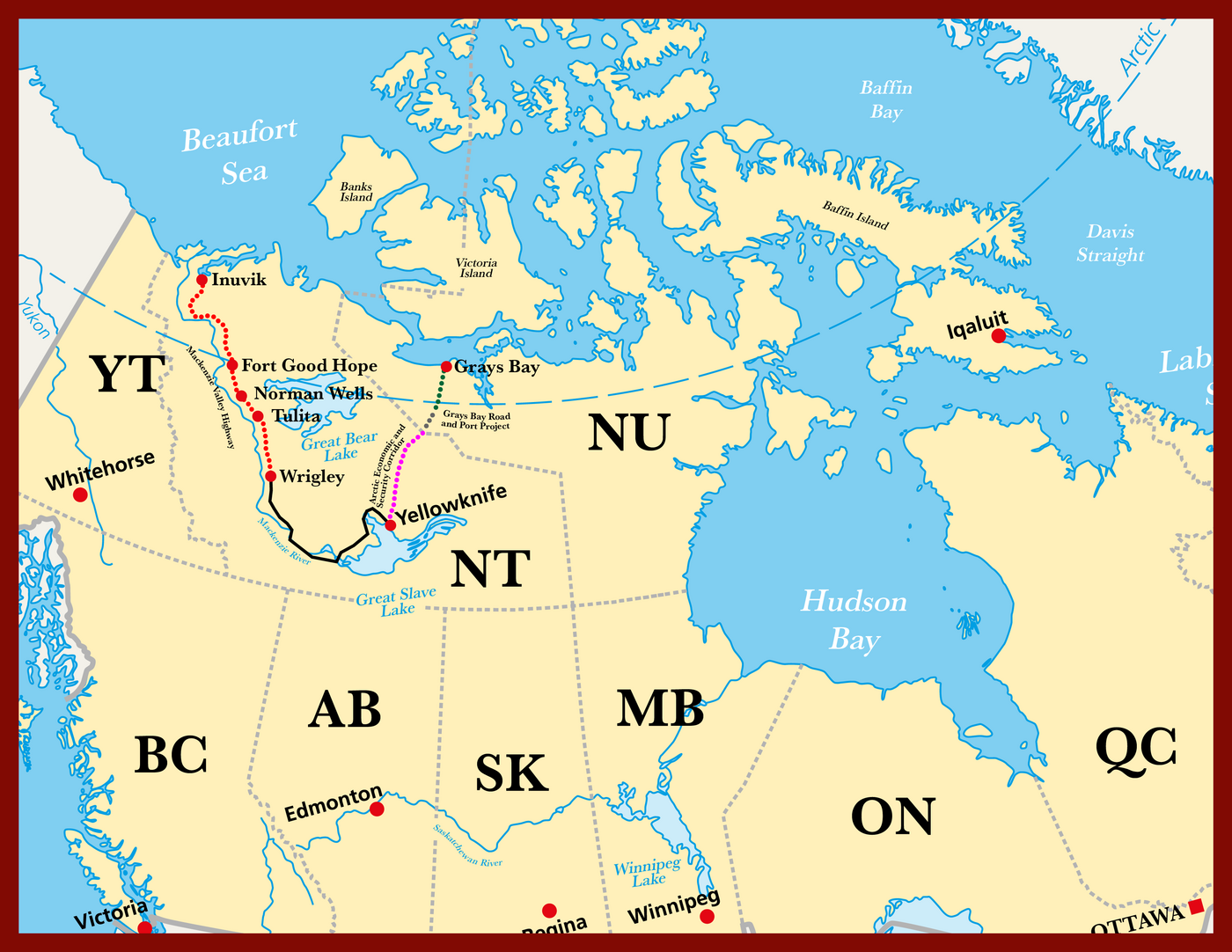
• Mackenzie Valley Highway is in the Northwest Territories.
• Arctic Economic and Security Corridor is in the Northwest Territories.
• Grays Bay Road and Port Project connect Nunavut and the Northwest Territories.
Note: All locations for these projects are approximate and subject to final routing decisions.